Settings
Every page of settings, and what each one changes.
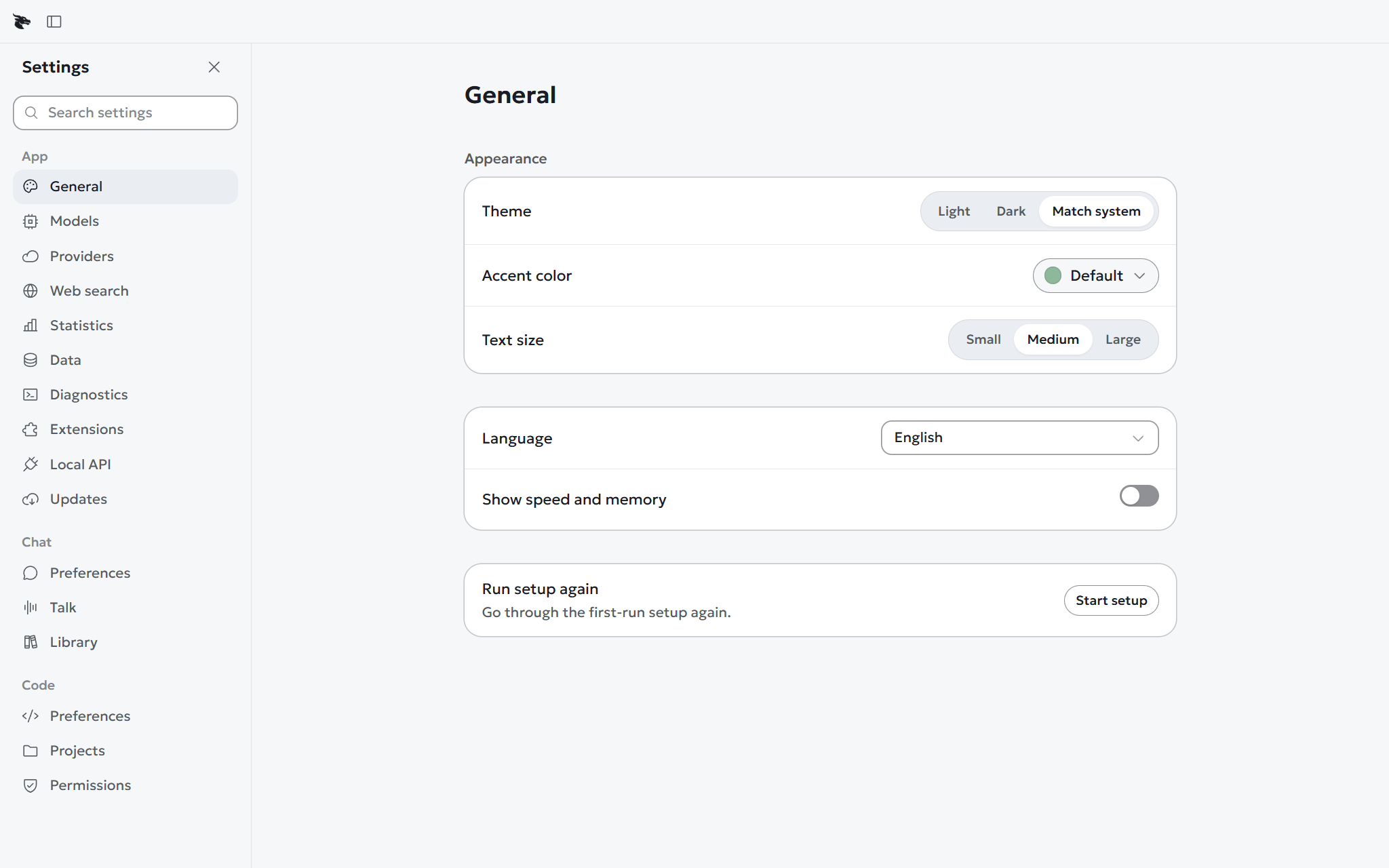
Three groups. App is Draggy as a whole, Chat and Code are each side's own. /settings opens the side you are on.
App#
| Page | Holds |
|---|---|
| General | Theme, text size, interface language (English, French, Spanish or Chinese), and the speed and memory line under each reply |
| Models | Every installed model, the Hugging Face browser to add more, context window, compaction limit, and an Unload button, plus the image model and image size |
| Providers | Servers on this computer, API keys, and plan sign-ins |
| Web search | Automatic, DuckDuckGo, Startpage, Brave Search, Brave Search API or SearXNG |
| Statistics | Replies, tokens, speed by model, tool usage, time per task, cost, budgets and editable prices |
| Data | What is stored, and clearing history |
| Diagnostics | The log folder, and Export diagnostics for bug reports. The export replaces your home folder and user name |
| Extensions | Servers, remote servers and skills |
| Local API | An OpenAI-compatible API on this computer, off by default |
| Updates | Current version, automatic updates, and a Check now button |
Chat and Code#
Each has Preferences: its model, thinking mode, web access and custom instructions. Chat adds Talk and Library. Code adds Permissions and Projects, where each project keeps its permission mode, its AGENTS.md or DRAGGY.md and everything you have always-allowed.
The Library page indexes a folder of documents by meaning, so searches in Chat find the relevant passages. Indexing needs an embedding model. Draggy uses the one you chose, or picks one sized to your graphics card and downloads it the first time you add a folder.
Custom instructions are added to every conversation on that side.
The local API#
On 127.0.0.1:11500, loopback only, Bearer key required, and requests carrying an Origin header are refused outright so a web page cannot reach it. It serves /v1/models and /v1/chat/completions.